
Introduction
If you’ve ever opened a credit card statement and seen a “minimum payment,” you might have wondered: Is paying the minimum enough? Why is it so much smaller than what I spent?
This credit card minimum payment explained guide breaks it down in simple terms. You’ll learn what the minimum payment is, how it generally works, what it can mean over time, and how to build a routine that reduces confusion.
Because credit cards can have different terms, this article focuses on general concepts rather than specific recommendations.
What Is a Credit Card Minimum Payment?
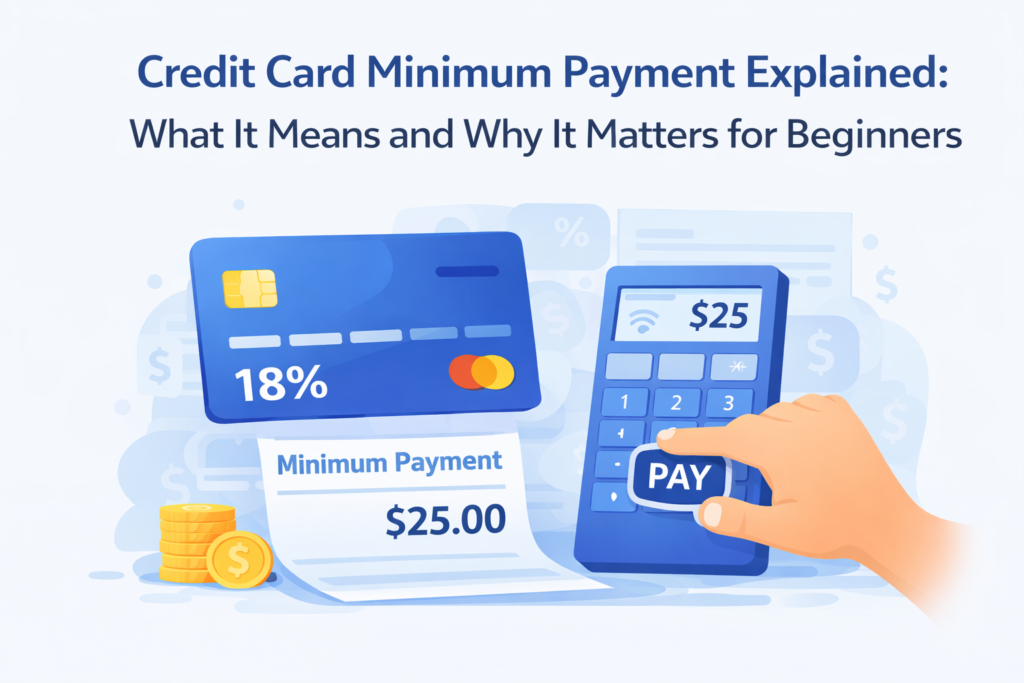
The minimum payment is the smallest amount your credit card issuer requires you to pay by the due date to keep the account current under the statement terms.
It’s not the “best” payment amount—it’s the minimum required to avoid being considered late according to the issuer’s rules (assuming it’s made on time and properly posted).
Where the Minimum Payment Appears
You’ll typically find the minimum payment on:
- your monthly statement (paper or digital)
- the account summary inside your credit card app
It’s often listed near:
- the statement balance
- the payment due date
How Minimum Payments Are Usually Determined (High-Level)
Card issuers use formulas that vary, but minimum payments are often based on a combination of factors such as:
- a small percentage of the statement balance
- plus any fees or interest (if applicable)
- and/or a fixed minimum dollar amount
Because the formula varies by issuer and card agreement, the most accurate details are in the card’s disclosure documents.
Beginner takeaway: Minimum payment formulas differ, but the purpose is similar: a required baseline payment to keep the account current.
What Happens If You Pay Only the Minimum?
Paying the minimum generally keeps the account current for that billing period, but it may leave a remaining balance.
Why that matters (general concept)
When a balance remains, the account may continue carrying that balance into the next cycle. Depending on the card’s terms, that can affect:
- how long it takes to pay down the balance
- total borrowing costs over time (if interest applies under the terms)
- how your monthly payment obligations feel
This is why many people view the minimum payment as a “safety floor,” not a long-term plan.
Minimum Payment vs. Statement Balance vs. Current Balance
This is a common beginner confusion.
Statement balance
The amount shown on your monthly statement when the billing cycle closes.
Minimum payment
The minimum amount required to keep the account current for that statement.
Current balance
What you owe right now (changes with new purchases and payments after the statement date).
Beginner tip: Always check which balance you’re looking at—statement balance and current balance often differ because of timing.
Why the Minimum Payment Can Feel “Too Small”
Minimum payments are often designed to be affordable enough to keep accounts current. But “affordable” doesn’t always mean “efficient,” especially if you’re trying to reduce balances over time.
Even when the minimum looks small:
- the remaining balance can persist
- the timeline to pay it off can extend
Exact outcomes depend on card terms, rates, and account activity.
What Happens If You Miss the Minimum Payment?
Missing a minimum payment can lead to consequences depending on the card agreement and timing, such as:
- late fees (if applicable)
- potential changes to how the account is treated
- negative reporting outcomes depending on how late and how reporting works
Because details vary, the safest habit is setting reminders and using a weekly money routine to avoid missed due dates.
Beginner Routine: How to Stay Organized Around Minimum Payments
1) Know your due date
Put it in your calendar.
2) Review your statement when it posts
Look at:
- due date
- minimum payment
- statement balance
- fees/interest line items (if shown)
3) Use weekly check-ins
During your weekly review:
- confirm upcoming payments
- make sure you’re not surprised by the next statement
4) Track spending patterns
Overspending surprises often lead to “minimum payment mode.” Tracking helps reduce that risk.
Common Mistakes Beginners Make
Mistake 1: Thinking “minimum payment = total amount owed”
Fix: Minimum payment is a required floor; statement balance is the billed snapshot.
Mistake 2: Not understanding timing
Fix: Learn billing cycle + statement vs. current balance.
Mistake 3: Ignoring fees
Fix: Review statement line items monthly.
Mistake 4: Missing due dates
Fix: Calendar reminders + weekly check-ins.
FAQ
What is a credit card minimum payment?
It’s the smallest amount required by the due date to keep the account current under statement terms.
Is paying only the minimum “okay”?
It generally keeps the account current for that cycle, but it may leave a remaining balance. Outcomes depend on card terms.
Why does the minimum payment change?
It can change with your statement balance, fees, interest charges, or issuer rules.
Where can I see how my card calculates the minimum?
Your card agreement and disclosures typically explain minimum payment calculation.
Final Thoughts
The minimum payment is a required baseline—not a complete strategy. Understanding how it relates to your statement balance and due date helps you stay organized and reduce confusion. A simple routine—monthly statement review plus weekly check-ins—makes credit card management far easier.